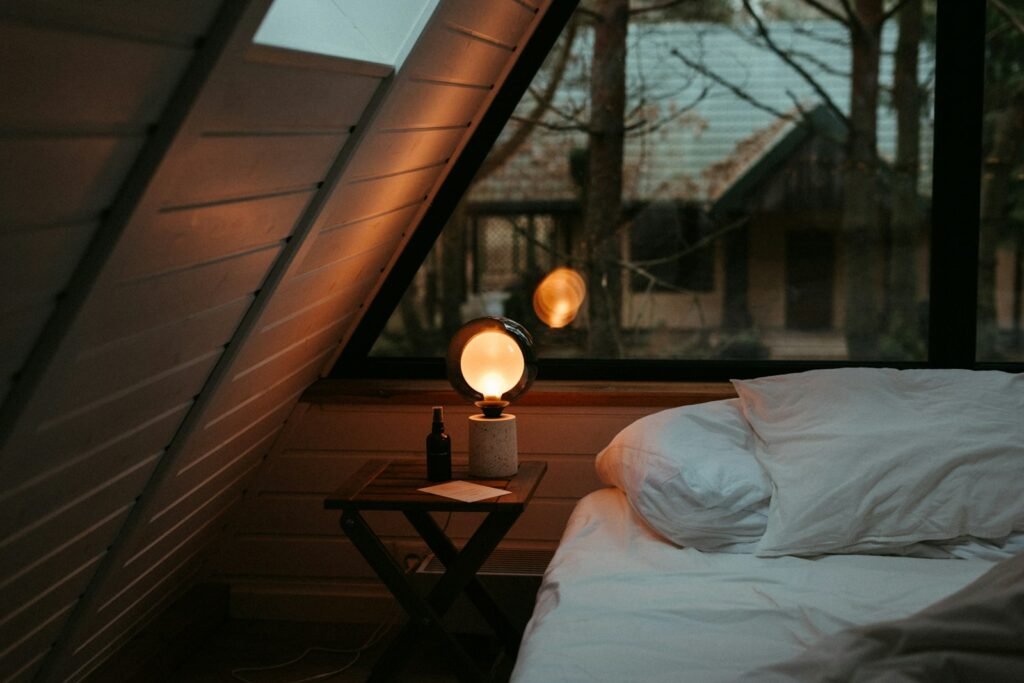
Here’s something I wish someone had told me years ago: when a small bedroom feels cramped or cold, the problem is almost never the furniture. It’s the light.
Most bedrooms come with one ceiling fixture in the middle of the room. Switch it on and you get flat, bright light that bounces off every wall and makes the space feel like a waiting room. Switch it off and you’re in the dark. There’s nothing in between, and “in between” is exactly where cozy lives.
The good news is that fixing this is cheap, renter-friendly, and takes an afternoon.
Why the overhead light is the enemy of cozy
Light coming straight down from the ceiling flattens a room. It wipes out shadows, which are what give a space depth. Small rooms suffer most because every surface is close by and everything gets lit equally.
Cozy rooms do the opposite. They have pools of light at different heights, with softer, darker areas in between. Your eye reads that contrast as warmth and intimacy, and oddly enough it can make a small room feel bigger, because the corners stop announcing themselves.
The three-light rule
You don’t need a dozen fixtures. In most small bedrooms, three light sources at three different heights does the job:
- Low: a bedside lamp, ideally with a fabric or paper shade so the light spreads sideways instead of glaring at you.
- Middle: something at eye level or slightly above, like a wall-mounted plug-in sconce, a small lamp on a dresser, or a string of fairy lights along a shelf.
- Accent: a soft glow somewhere unexpected: behind the headboard, under the bed frame, or a small LED lamp tucked into a corner.
Once these three are in place, try living a full week without turning on the ceiling light in the evening. Most people never go back.
Get the bulb color right first
This matters more than the lamp itself. For bedrooms, look for bulbs labeled 2700K or lower, often sold as “soft white” or “warm white.” Anything around 4000K and above is daylight-style light: great for a kitchen, harsh in a room where you want to wind down.
If you want to go a step further, a dimmable bulb (or a plug-in dimmer for an existing lamp) gives you control over the mood. Bright enough to find your socks, dim enough to read before sleep.
Small-room tricks that actually work
- Use walls instead of floor space. Plug-in wall sconces free up your nightstand and don’t need an electrician. The cord runs down to a regular outlet.
- Light the wall, not the room. A lamp placed near a wall washes it with light, which makes the room feel wider.
- Hide the source. A warm LED strip behind a headboard or along the back of a shelf gives a glow without a visible bulb.
- Add one mirror. A mirror opposite a lamp doubles its effect at night.
👍 Pros
- Cheap and renter-friendly
- Makes the room feel larger at night
- Better for winding down before sleep
👎 Cons
- More cords to manage
- Need a few minutes to switch several lights on
A simple starting setup
If you only want to buy one or two things this week, here’s where I’d start:
- Swap your bedside bulb to a warm 2700K one.
- Add one mid-height light source. A set of warm-white fairy lights draped along a shelf or curtain rod is the easiest win.
- Put the lamps on a smart plug or a single power strip so they all switch on together. That removes the “too much effort” problem completely.
The bottom line
A cozy small bedroom isn’t about buying more things. It’s about turning off the big light and replacing it with a few smaller, warmer ones at different heights. Start with the bulb, add one lamp, and see how the room feels after dark. You’ll notice the difference the very first evening.
Photo: Polina Kuzovkova on Unsplash.